

International racing moves at such a gallop these days that it's hard to catch a breath and appreciate one stellar achievement before another overtakes it and commands interest.
It's not just the news cycles that keep the likes of political development churning, either. There are actual accomplishments to celebrate, history to be carried forward, money to be made, and planning to be done.
Before new marvels intrude, let's have a look at the economics underpinning Romantic Warrior, then turn to savoring the tradition of Royal Ascot.
Hong Kong
Turn the calendar back just a few days to May 24 and the Champions & Chater Cup (G1) at Sha Tin Racecourse with Romantic Warrior lined up for the 2,400-meter (about 1 1/2-mile) final leg of the Hong Kong Triple Crown.
Everyone who follows these things even casually knows the outcome. He won the race and swept the crown—a remarkable achievement for any horse but even more remarkable for an 8-year-old with more frequent flyer miles to his credit than the most devoted tourist.
Honors and titles aside, he also extended his world record earnings to HK$288.7 million (about US$36.8 million), by the Hong Kong Jockey Club's accounting.
That's a lot of money. It seems like yesterday that Cigar fell just $185 short of $10 million in career earnings when he finished third in his swan song, the Breeders' Cup Classic (G1) at Woodbine in 1996.
But Romantic Warrior came soooo close to much more.
His dramatic second behind Forever Young in the 2025 Saudi Cup (G1) cost owner Peter Lau $6.5 million—the difference between the $10 million winner's share and $3.5 million for second. His second to Soul Rush in the Dubai Turf (G1T) just five weeks later was another $1.9 million hit with $2.9 million for the winner versus $1 million for second. A neck and a nose equals $8.4 million and he now would have a US$45.2 million bank account.
Sigh. Still, no tears for Lau. He secured Romantic Warrior for HK$4.8 million (about US$630,000) at the 2021 HKJC auction. And the Club got him at the 2019 Tattersalls October Yearling Sale for 300,000 guineas (US$396,948). Everyone made a profit.
But, as the direct-market ads say, "Wait. There's more." Maybe.
Romantic Warrior might not be done, even at his relatively advanced age and his 2025 surgery after the Middle East trip and nearly seven months on the sidelines.
Trainer Danny Shum said the veteran campaigner might join Hong Kong's other superstar Ka Ying Rising at the HKJC's Conghua Racecourse and training center on the Chinese Mainland while he and Lau ponder a 2026-27 campaign.
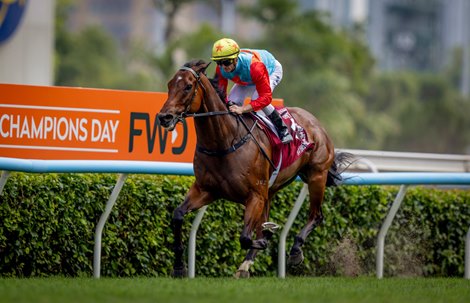
"The plan is to give him a break," the trainer said. "I will think about whether to send him to Conghua, same as Ka Ying Rising. Ka Ying Rising is very happy (there). So, I might send him to Conghua, give him a little break, and then see how he goes.".
If he does return, the logical target is the Hong Kong Cup (G1) on International Day in December, with a winner's share of HK$22.4 million (about US$2.86 million). Romantic Warrior has already won that race four times but there are no fresh targets left on the local schedule.
An aside: Hong Kong Jockey Club CEO Winfried Engelbrecht-Bresges points out that Hong Kong is host to two of the world's five top-rated horses despite having a racing population of only some 1,300 horses and without a breeding program. Romantic Warrior, Ka Ying Rising, and a potential emerging star My Wish, swept the three group 1 events on Champions Day April 26, turning back high-quality fields from around the globe—an event Engelbrecht-Bresges called "one of the best, if not the best, race meetings ever in Hong Kong."
Royal Ascot
While Hong Kong's emergence as a top-shelf player on the international scene is a recent development, bolstered by well-implemented business practice and strict, true-to-mission performance, Royal Ascot's carriages roll down the racecourse next month with history and tradition as the prime additions to the straight-on quality of racing.
The royal meeting runs five days, from June 16-20. Is it the same since Her Majesty Queen Elizabeth II died? Of course not. But it's still the royal meeting. The King and Queen attend and there's no less pomp and pageantry for the populace or glory for the winners.
A few moments in racing are special, for reasons difficult to define. For Americans, it's the strains of "My Old Kentucky Home" as the horses emerge from the plush new Churchill Downs paddock for the Kentucky Derby (G1). The entirety of Royal Ascot fits the description for anyone not totally jaded. And the advent of pillar-to-post televised coverage makes the fashion, the tradition, the royal aura available to all.
Then there's the racing. During the past few months, we've been examining the impact that star horses and bombshell race meetings can have in generating and percolating fan interest. The surge of international participation has boosted Royal Ascot into that arena in its own unique way. Australia and Japan have tough contingents this year and the United States will be represented, including some 2-year-old hopefuls in group 1 events.
How well regarded is the meeting around the world? Trainer Yoshito Yahagi nominated the world's top-rated dirt horse, two-time Saudi Cup winner Forever Young, to the Prince of Wales's Stakes (G1), which, of course, is run on the Ascot turf.
"It is very prestigious for a trainer to have a runner at Royal Ascot," he said. "I think it is a very attractive idea to send Forever Young for the Prince of Wales's Stakes, although he has had an easy time since he returned from the Middle East."
Forever Young isn't coming to Ascot. But the thought was there.
Americans can expect to root for trainers Wesley Ward and George Weaver, who hold early entries in group 1 races. Others will be scattered through the five days.
And, speaking of the carriages that tote the royals and their most honored guests down the racecourse to the Royal Enclosure to start the day—2026 is the 201st anniversary of that tradition.
News and Notes
Long-standing plans to boost the Greater Bay Area in southern China as a seamless, biosecure center for all types of equine competition got what's described as a "major step forward" recently with a plan to establish the first World Organization for Animal Health Collaborating Center for Equine Health and Movement.
The concept comes from an April workshop hosted by the HKJC involving some 80 representatives from veterinary authorities, equestrian federations, and racing jurisdictions from 17 regions and countries. The WOAH and the International Horse Sports Confederation initiated the meeting.
Officials stressed the planning is conceptual. But it bears close watching given the successes of the HKJC's cross-border protocols to its Conghua Racecourse on the mainland and the signing in 2021 of an agreement with the Guangzhou Municipal Government to further the National Equine Industry Development Plan 2020-25 promulgated by the Ministry of Agriculture and Rural Affairs and General Administration of Sport.
The ultimate goal, the HKJC said at the time, is to "allow a thriving equine industry to take hold in the GBA in future," starting with sustainable, international standard racing at Conghua as the anchor of a "Guangzhou-Hong Kong Racing Economic Cluster".
Regularly scheduled racing at Conghua, originally slated for April, has been pushed back to November.
The international impact of a fully developed commercial racing industry in China, needless to say, would be colossal.