

For years the major players in Arkansas racing have credited the cooperation of track executives, horsemen, and regulators in moving horse racing forward there, which made Oaklawn Park an appropriate setting for a March 4 keynote address to the National Horsemen's Benevolent and Protective Association conference from Everett Dobson, chairman of The Jockey Club.
While The Jockey Club and National HBPA have been on opposite sides regarding the Horseracing Integrity and Safety Authority, which The Jockey Club supports but the National HBPA has fought through litigation, Dobson called for the organizations to come together on the many issues where they have common ground. He cited cooperation in Arkansas as an example of why the industry needs to continue to talk with one another and craft ideas to move racing forward.
"In 2022 at this very conference when speaking about the success of Oaklawn Park, Louis Cella said, 'It would not have happened without our firm relationship with the Arkansas HBPA. We check our agendas at the door,'" Dobson said of the Oaklawn Park president's comments.
Dobson said that racing on the national level could learn from the Arkansas example.
"If we are serious about thinking big—truly big—our future will not be built in silos, it will be built at big tables," Dobson said.
In a room filled with horsemen, plenty familiar with industry challenges, Dobson acknowledged several of those issues, but said through cooperation, the sport could find a way forward to real success. Dobson, a horse owner and breeder who is also a part-owner of the NBA champion Oklahoma City Thunder, cited the NBA's story in the 1980s as an example of how a sport can turn around its fortunes.
"I've been a sports nut all my life. I have seen how major and minor sports have functioned from afar. I have seen the NBA from the inside. I can tell you this with complete certainty: Sports and sports leagues function best when there is collaboration toward a common goal," Dobson said. "My belief is that horse racing can raise to a far higher level of participation and fan engagement. For that to happen we need collaboration and unification."
Video
Dobson noted that both The Jockey Club and the National HBPA know racing owes any of its success to the horse. While he credited HISA as helping the sport make important strides in equine safety, he noted that horsemen also have been critical in those improvements that have put the sport in a position to advance.
"As I look around this room and look at the mission statement and position statements of the HBPA, it's apparent that when it comes to the horse, we are as closely aligned as two organizations could possibly be," Dobson said. "The improvements this sport has made in the health and safety of the Thoroughbred racehorse is, I think, the single most important thing I have seen in my now 30-year involvement. I am also of the belief that credit for that should be spread far and wide and especially to the great horsemen that make up HBPA.
"You are the ones putting your hands on the horse, providing for the care and nutrition needs for every single horse, every single day."
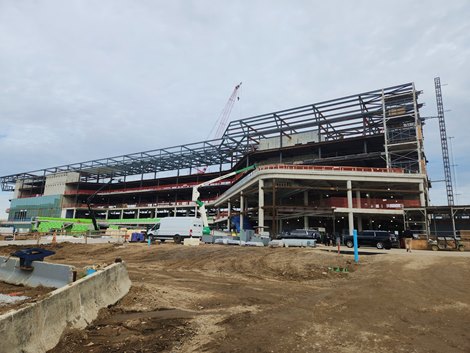
Dobson then outlined reasons for optimism and how the sport can progress. He noted that new tracks or renovations are being built or planned for the sport's Triple Crown hosts—Churchill Downs, Pimlico Race Course, and Belmont Park—and popular tracks such as Keeneland and Oaklawn Park. He also noted that projects in smaller racing states, such as Nebraska, Kansas, Wyoming, and Arizona, are fueling optimism.
Dobson said he's committed to developing a national marketing campaign for horse racing, and he credited current efforts through the influencer program created by The Jockey Club's America's Best Racing as bringing new eyeballs to the sport in 2025. He said that program will be expanded and he looks forward to new marketing ideas.
"My belief is that horse racing can raise to a far higher level of participation and fan engagement," Dobson said, noting that such success has occurred in pockets throughout the country. He said for that to happen on a broader level, collaboration and unification are needed. "Nothing big in this sport will happen if we can't improve our fan engagement. Over time new fans will translate to new bettors and increased handle. Some of these fans will become breeders and farm owners."
Reaching people will be key, and Dobson is confident the sport can connect with people just as the NBA has.
"We have an amazing story to tell," Dobson said. "It's time to start telling it."
While Dobson acknowledged that breeding activity outside of Kentucky has declined, he noted that The Jockey Club hosted a conference to address these challenges. He said a point of emphasis is states working together, and he came away convinced that states are going to broaden their breeding and racing programs in partnership with surrounding states. He encouraged horsemen with any ideas in this area to share them.
Horsemen in attendance were encouraged by the message. Eric Hamelback, CEO of the National HBPA, said disagreements will continue, but he still sees an opportunity to work together.
"I think everyone in this room thinks we can move this industry forward," Hamelback said. "We hope in the future there's more collaboration—working with us and working together."
"I think it was a great message," said Arizona HBPA president J. Lloyd Yother. "Like he says, we have to cooperate. We're going to have our differences, but we're going to have to cooperate and sit down and work through the issues. You can't stick your head in the sand and close the door and say my way or the highway. It just doesn't work."
Arkansas HBPA president Bill Walmsley said his state has seen the fruits of the cooperative approach. He appreciated Dobson's message.
"We need to have dialogue. It's important for this industry for us to have dialogue. We're too small to be fighting among ourselves," Walmsley said. "We need to find some middle ground. This is a good first step."
Dobson also used the opportunity to outline The Jockey Club operations, noting that, like the NBA, it's a non-profit entity with investments in for-profit subsidiaries. He outlined how that money goes back into the industry, in many cases, in line with initiatives the National HBPA also supports.
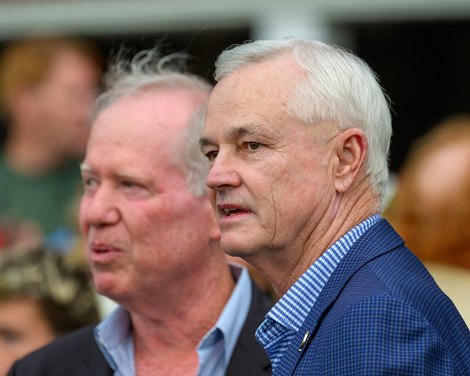
"The Jockey Club has a cash reserve of just over $41 million that has been on its balance sheet for many years," Dobson said. "Earnings from those cash reserves, plus any profits from subsidiaries, are distributed annually every year to over 50 industry programs and initiatives. Many of our initiatives are your initiatives; two examples are the Racing Officials Accreditation Program and the Race Track Chaplaincy of America program.
"The very fabric of our sport is being held together by the organizations we support, you support, and many others support."
Since becoming chairman in July, Dobson has taken a fresh look at The Jockey Club's businesses. He credited the staff at The Jockey Club for embracing this approach, including a pair of children of prominent trainers: Chance Moquett, who oversees strategic projects and business development at Equibase, and Charlotte Clement de Bona, who serves as chief strategy and transformation officer.
"That exercise is ongoing, but I think it's important to know how we are approaching this. First, we must stay true to our mission," Dobson said. "We're asking ourselves a lot of questions. Are we meeting the needs of our customers? Are the products and services evolving as the industry evolves? Is our technology evolving? Are our costs in line? My goal quite simply is to make The Jockey Club more successful by making our customers more successful."
Through cooperation, Dobson believes the sport can turn things around.
"Can we elevate this sport to a level that hasn't been seen in a generation?" Dobson asked. "I believe we can, with a commitment to collaboration, integrity, unification, and a big dose of big ambition."